Synthux Design Residency
A year-long, fully sponsored program for developers and hackers who want to design their own hardware instrument — and actually finish it.
Applications open until July 12th 23:59 CEST
Apply nowDesign your very own hardware instrument
The Synthux Residency is a program that takes you through the process of designing an instrument from concept to completion. You work in a small cohort. You start on shared hardware, move to designing your own instrument, and finish with something you can demo at Superbooth 2027.
The residency is ran by Roey Tsemah, Synthux Academy founder and the designer behind Spotykach, Simple Touch, Audrey II and the Simple Synth Designer kit. The sessions are part workshop, part critique, part troubleshooting. You'll have a private cohort space, a dedicated private channel in our Discord, and a resource library — firmware, UX, and hardware guides — built specifically for this program.
It's not an online course but an actual hands-on learning experience. Not just a curriculum to complete with a certificate at the end — you design a real, physical instrument and we make sure you're not doing it alone.
Who this is for
You have an idea. Not a finished spec, but a direction. You know roughly what instrument you want to make, and why it should exist. Vague enthusiasm for synthesis isn't enough; there should be a real question you're chasing.
You can hack things together. Not necessarily C++ or DSP. The attitude matters more than the stack — you're comfortable figuring things out, breaking them, and asking for help when you're stuck. Experience with plugins, open-source music software, or embedded projects is a bonus.
You have the time, and you'll show up. We meet every two weeks for about 1–2 hours, and you'll need a few hours to allocate for development between sessions (4–5 hours a week, but you know better how much time you need). The residency works because people keep turning up — for the process, not just the finish line.
It's probably not for you if you want someone to build it for you, or a course to passively follow.
What instruments came out of the last residency?
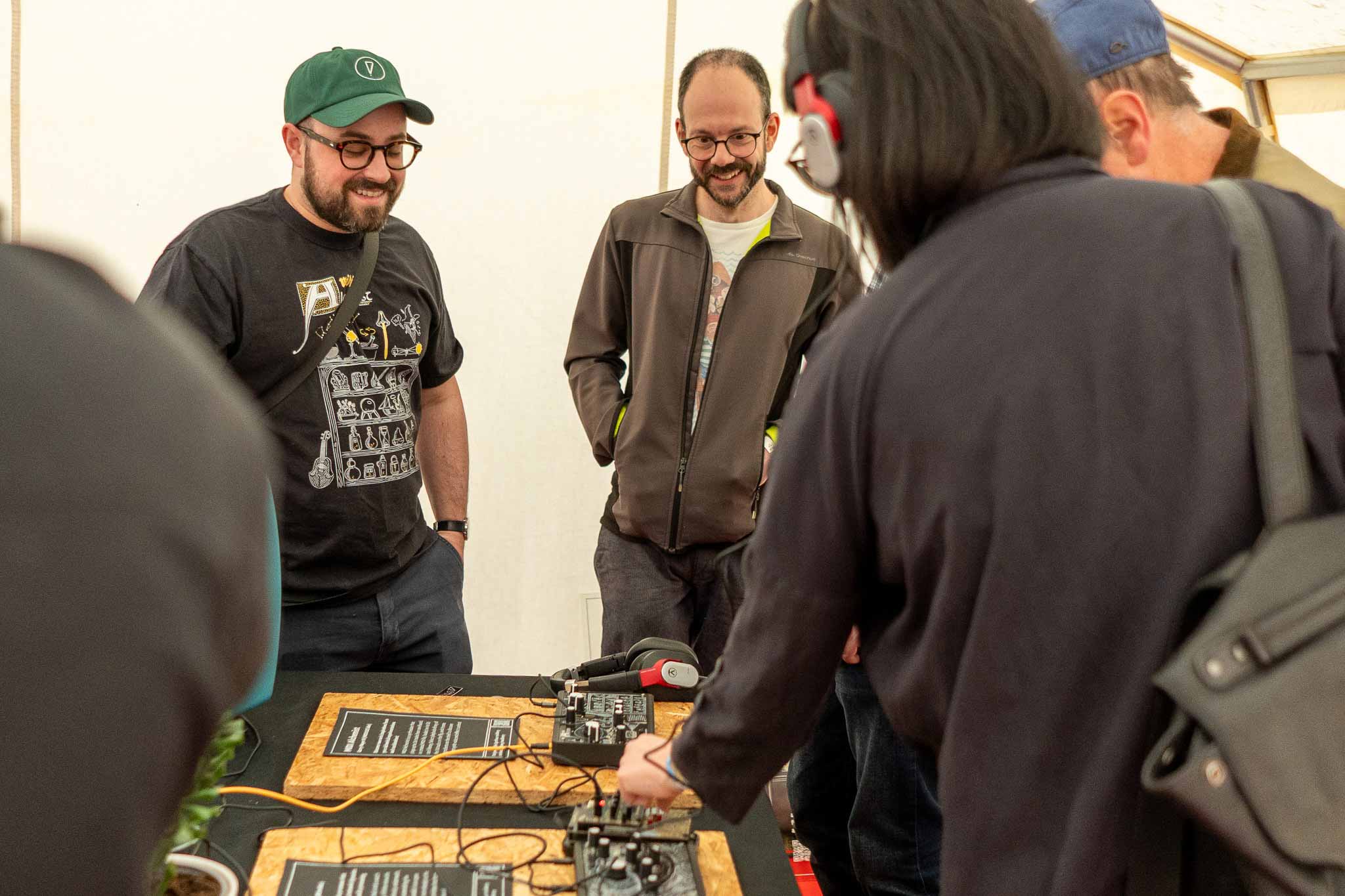
At Superbooth 2026 we've presented the results of the last cohort - two instruments by Gerry Mayer and Crisitan Pandele. Check out their work below:
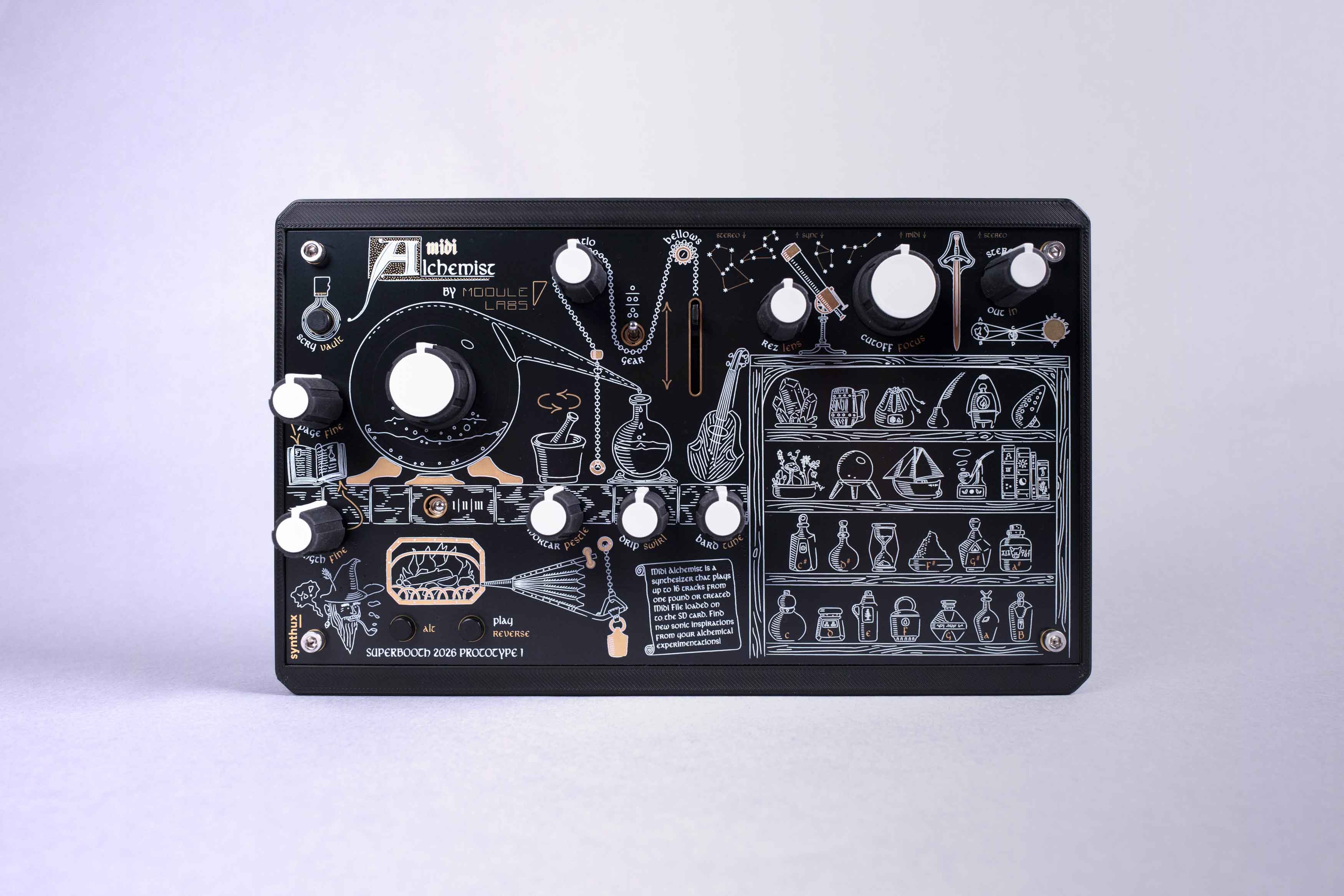
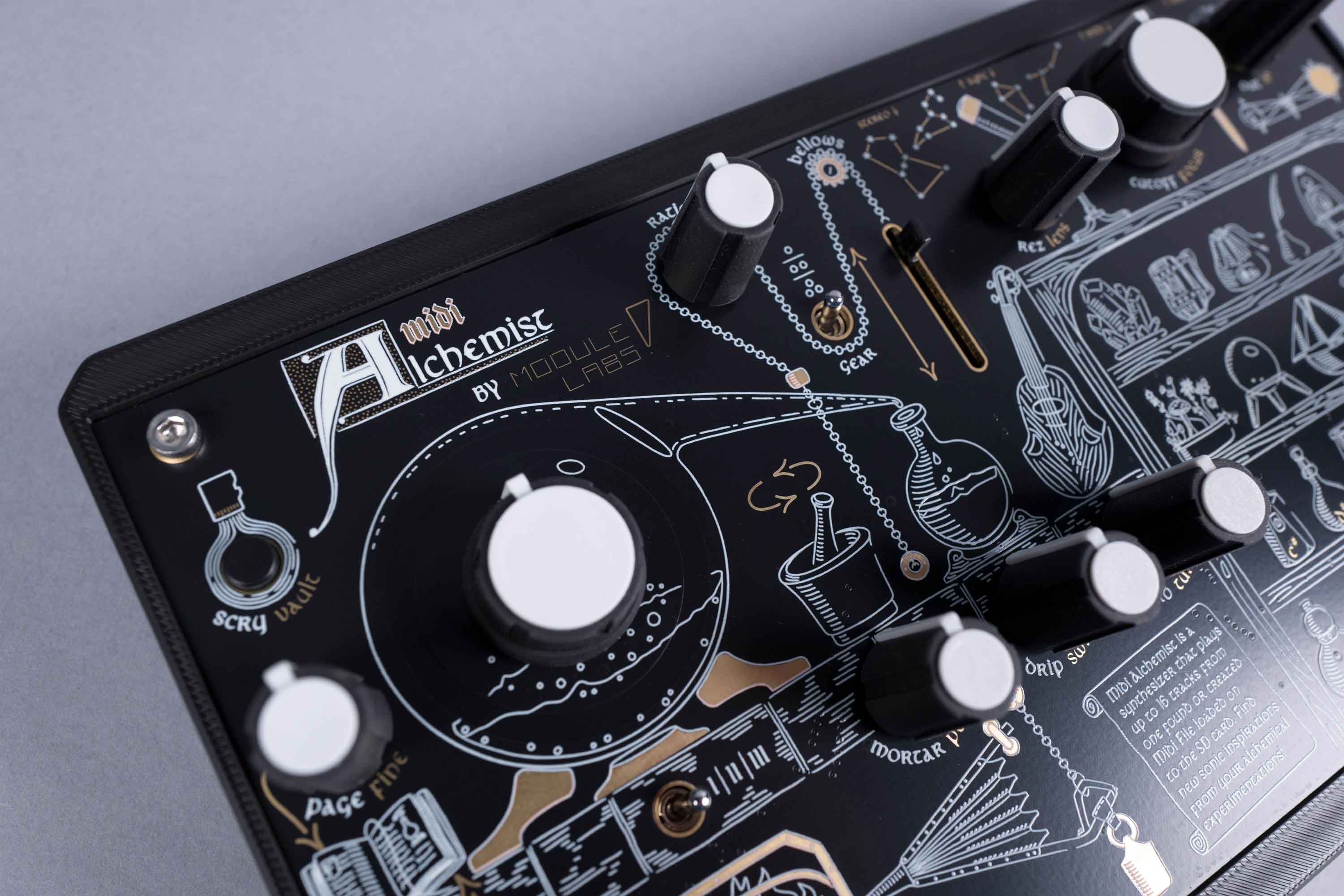
Gerry Mayer — MODULE! labs, Chicago. Built MIDI Alchemist, a synth that plays up to 16 tracks from a MIDI file on an SD card, with live track selection and voice/effect combinations.
Starting with Simple Designer, I've known for years that Synthux Academy is something unique and special, and being a part of the first Synthux synth design residency cohort has empowered me to transform an idea for a synth into a reality. Roey and the fellow residents have formed a powerful, collaborative group where feedback and support helped guide me to learn all the steps of designing, coding, and even illustrating a synth front panel into a cohesive vision. As I write this, I'm about 2 weeks away from exhibiting the first prototype of MIDI Alchemist with Synthux at Superbooth 2026 and it all feels like a dream! I couldn't encourage the residency program more! — Gerry Mayer III (MODULE! labs)
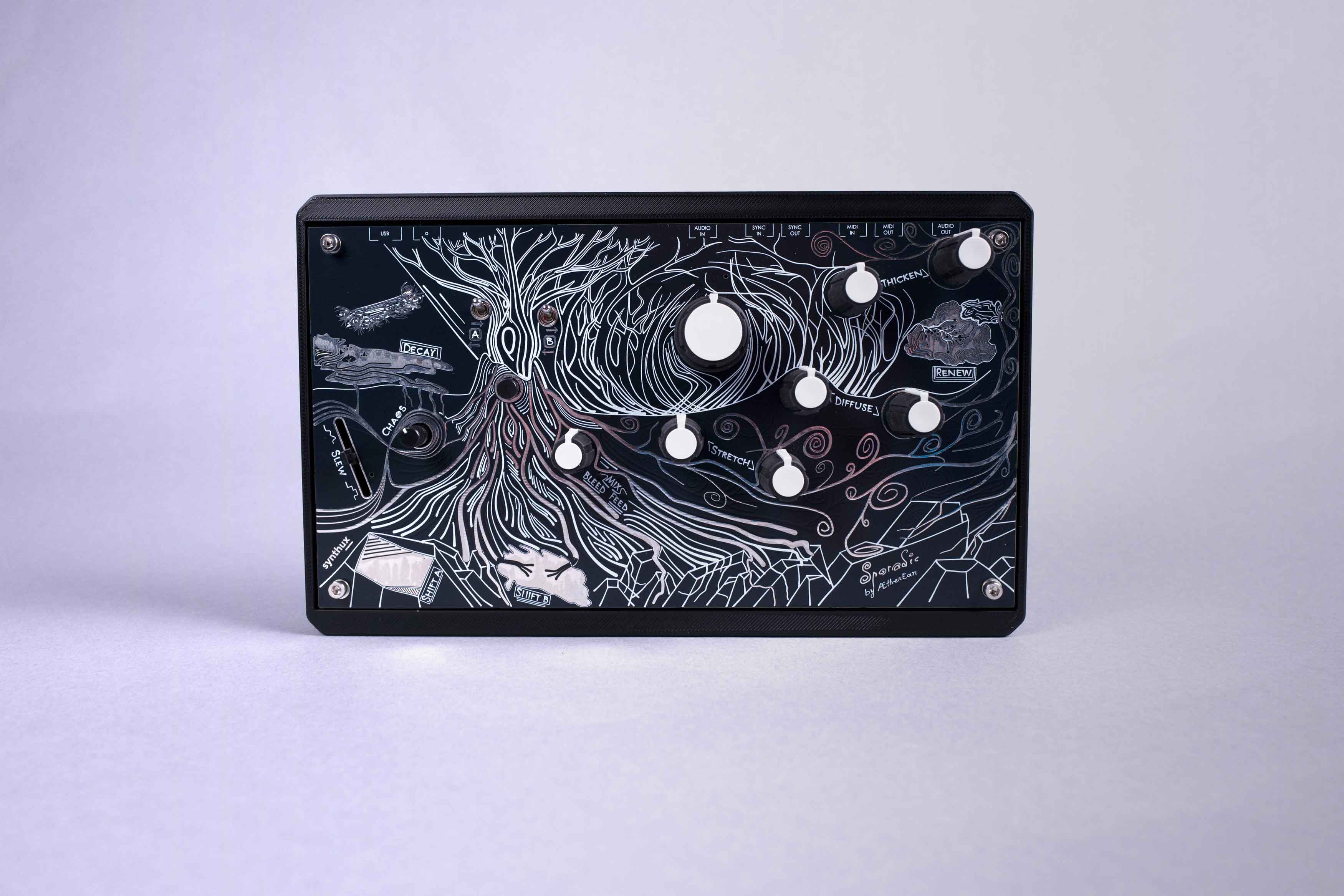
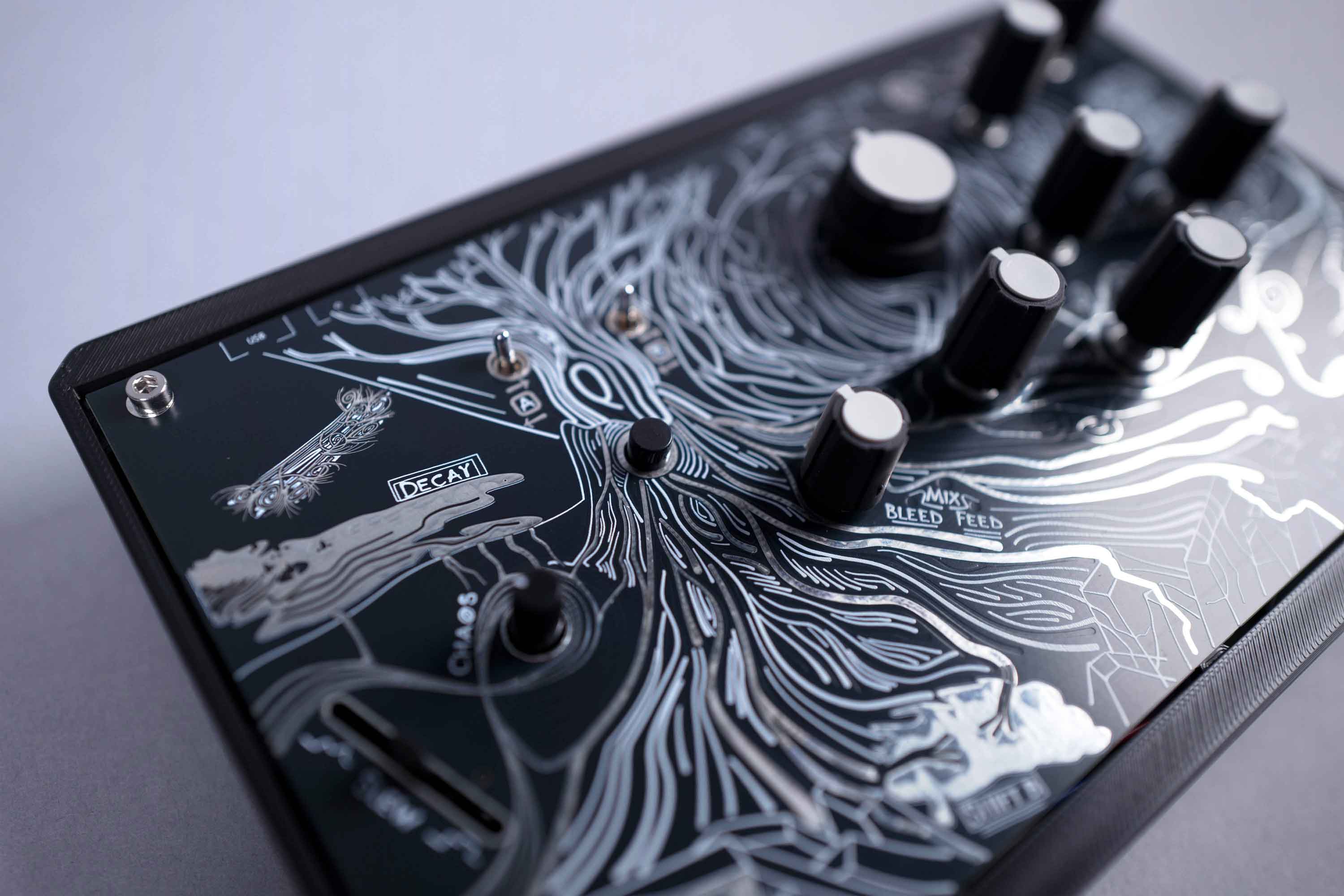
Cristian Pandele — ÆtherEar, Copenhagen. Built Sporadic, a biomimetic audio processor that turns mycelial network dynamics into delay-based processing.
How many times have you sat in the studio and came up with an amazing patch, thinking to yourself: "man, this would make an awesome instrument, if only I had the time to prototype, polish and manufacture it..."? I came into the first Synthux residency cohort with an idea like that and, under a year later, I need to pinch myself as I have the chance to exhibit the prototype at Superbooth! As a chronic tinkerer, the residency offered the cure: Roey's guidance and a community that encouraged iterating and sharing progress with each other, exchanging feedback on so many design facets, and constantly improving the instrument. I tried so many tools I had zero experience with, fully trusting that it's OK to not get it right the first time, or the second. The Synthux residency was instrumental in turning our shared passion into reality! — Cristian Pandele (ÆtherEar)
The hardware
Phase 1 — Spotykach
Phase 1 runs on Spotykach — our open-source dual-deck looper, built on the Daisy Seed. Starting here means you skip weeks of toolchain setup and start designing on day one. The cohort speaks the same language from the start. And because Spotykach has real players, your experimental firmware gets tested by people who'll actually use it.
Phase 2/3 — Custom hardware
Once we got something working and iterated with user feedback, you'll move to designing your own instrument. During these phases we work on an architecture designed specifically for this residency. The deep engineering is already solved — stereo audio I/O, MIDI in and out, CV I/O, and an SD card slot, with all of that circuitry placed along the top and bottom edges. That leaves the entire middle of the board open.
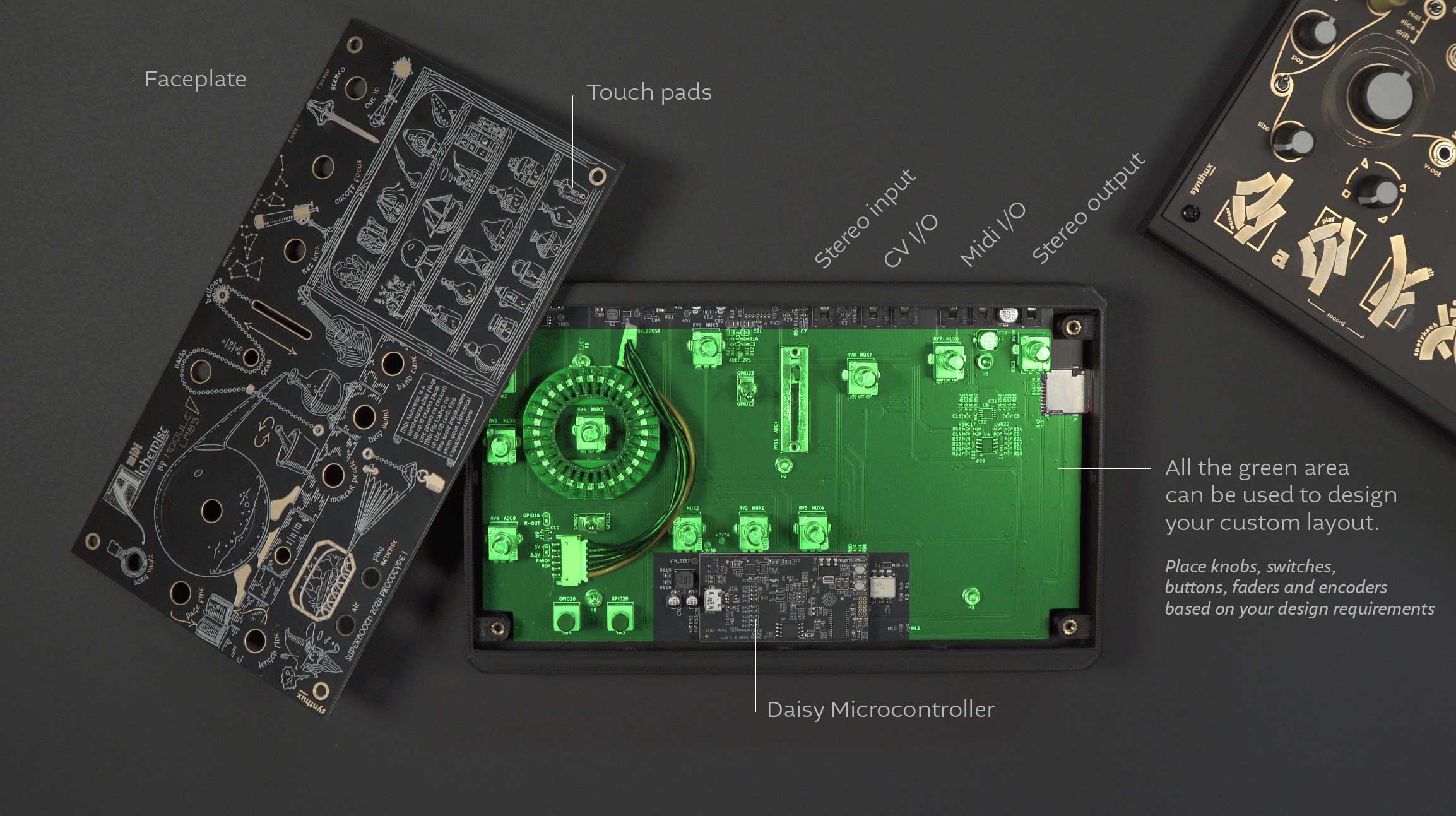
What you do with it is yours. You place your controls — knobs, encoders, faders, switches, touch pads, buttons — (almost) anywhere you want. You design your original faceplate. You decide what the instrument is and how it feels to play. Want to explore other sensors? That's possible too.
This is your custom hardware. The platform handles the parts that would otherwise eat most of a year, so the time you spend is spent on the instrument itself — not on debugging power rails. That's what makes finishing a real, original instrument realistic in ten months.
Timeline
July 2026
Selection
Apply until July 12 23:59 CEST. Interviews July 13–15. Final decision July 16th.
Aug–Nov 2026
Phase 1
Design on Spotykach. Get real user feedback from actual players.
Dec 2026–Feb 2027
Phase 2
Design your own instrument on the residency board.
Mar–May 2027
Phase 3
Final tweaks and prep for Superbooth.
May 2027
Superbooth, Berlin
Present your instrument.
Ownership and IP
You own your work. Everything made in the residency is released open-source — that's the spirit of the program, and part of how your instrument finds players.
FAQ
Do I need to know C++?
To a certain degree, yes, but you don't need to be an expert. We work with C++, and have lots of resources and people to help if you get stuck. We care more about whether you can figure things out than what language you already know.
Do I need hardware engineering experience?
No. Phase 1 is firmware and UX on existing hardware. Phases 2 and 3 move to designing your own instrument on the residency board, with guidance throughout.
Why design on a shared board instead of a from-scratch PCB?
Because it's how we can actually support you and how the cohort supports each other. When everyone's working on the same underlying hardware, a fix, a tutorial, or a hard-won "I got the touch pads working" helps all five of you instead of just one person. Designing a complete audio/MIDI/CV board from scratch would eat most of the year before you'd touched the instrument design itself. We've solved that part, so you can spend the time designing something original. The faceplate, the layout, the instrument: that's all yours.
Can I use my own sensors or controls?
Within the board, you have a lot of room — knobs, encoders, faders, switches, touch pads, and buttons go almost anywhere, since the I/O lives on the edges. You can also explore alternative sensors to a degree. If you've got something unusual in mind, raise it in your application and we'll tell you honestly whether it fits.
How much time does it take?
We meet every two weeks for a 1–2 hour session/workshop. Other than that you should allocate 4–5 hours a week for your own development.
What does it cost?
The residency is fully sponsored. You'll need your own Spotykach unit to start Phase 1, and prototype manufacturing for Superbooth typically runs €300–500. That's it — we're honest about it up front so there are no surprises.
Do I need to be in Rotterdam?
No, we run the program online. Of course, if you're in the Netherlands you're very welcome to visit us!
Who owns what I make?
You do. It's released open-source.
Apply
Four to five spots. Cohort 2026–27. Applications close July 12, 23:59 CEST.
Apply now